
Why Law Enforcement Needs Specialized Social Media Tools
A decade ago, law enforcement officers could manually review a suspect's public social media profile and screenshot anything relevant. Two things have changed that approach: scale and standards.
Scale: an active social media account can contain thousands of posts, hundreds of videos, and years of comment threads. A single TikTok or Instagram account relevant to a domestic violence case, a drug investigation, or a fraud prosecution may hold more spoken content than a week of recorded phone calls. Reviewing it manually, at even a minimal level of thoroughness, is not a realistic use of investigator time.
Standards: courts have raised their expectations for digital evidence. A screenshot is increasingly insufficient. Prosecutors and defense attorneys now routinely argue about whether social media evidence was properly preserved, whether the metadata is intact, and whether the collection process was defensible. Law enforcement agencies that cannot answer those questions competently are losing cases they should win.
Specialized social media investigation tools for law enforcement address both problems: they process account content at a scale no human can match, and they produce evidence packages that meet the authentication and chain-of-custody standards courts expect. See also: how law enforcement uses social media evidence in criminal investigations.
The Investigation Workflow: From Tip to Courtroom
Understanding the investigation workflow clarifies which tool category is needed at which stage. Most social media investigations follow a consistent pattern:
- Lead development: a tip, a search, or a referral identifies a person of interest and potentially relevant accounts. At this stage, the need is rapid discovery: find the relevant accounts, map connections, identify associated identities and platforms.
- Account identification and vetting: confirm that the account(s) are linked to the subject of interest, understand the posting history, assess the value of the account as an evidence source.
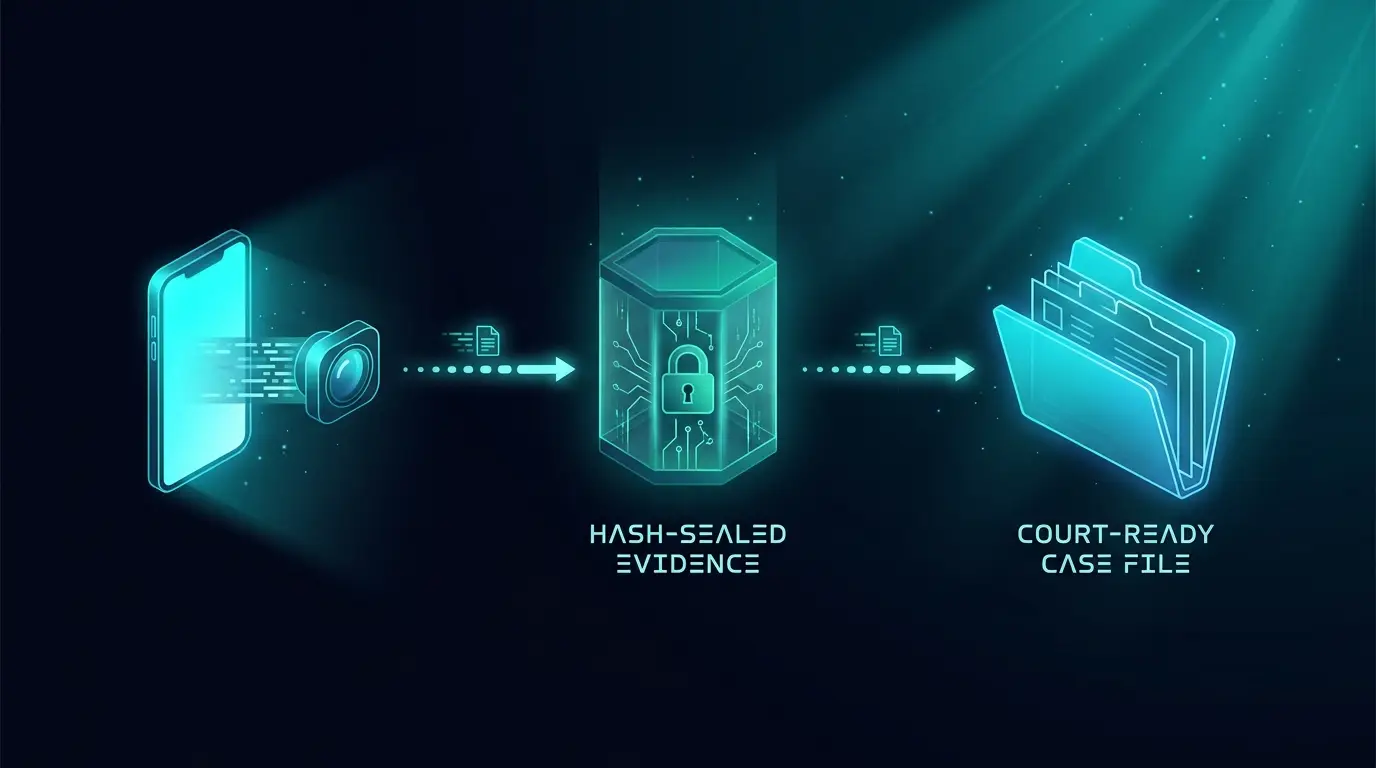
- Evidence preservation: capture the full content of relevant accounts before anything is deleted, edited, or taken private. This step is time-critical and forensically sensitive: the output must be court-ready from the moment of capture.
- Evidence review: search, filter, and analyze the captured content to identify what is relevant. For video-heavy accounts, this requires transcription. For large accounts, it requires keyword search across the full archive.
- Case file preparation: export the relevant evidence in a format suitable for the case file: hash-verified, documented, with a clear provenance trail that the prosecutor can present and defend.
No single tool category covers all five stages. Agencies that think they need one tool usually need two: an OSINT and intelligence tool for stages one and two, and a forensic capture platform for stages three through five.
Tool Categories Explained
OSINT and link-analysis platforms
These tools help investigators discover and map publicly available information. Maltego is the best-known example: it aggregates data from dozens of public sources and visualizes connections between people, accounts, domains, phone numbers, and email addresses as node graphs. Tools in this category are powerful for identifying who controls an account, what other platforms a subject uses, and how individuals in a network are connected.
What they do not do: capture and preserve content with forensic integrity. The output of an OSINT platform tells an investigator where to look; a forensic capture tool then preserves what they find. These two functions should not be conflated.
Real-time monitoring and keyword alert tools
Monitoring platforms track public posts for specific keywords, hashtags, accounts, or patterns as they appear. For threat assessment units, public safety teams, and counterterrorism analysts, real-time monitoring can provide early warning of developing situations: a threat posted to social media, a planned gathering, or coordinating language in public groups.
The limitation for investigative use: monitoring tools capture what they are configured to monitor, going forward. They do not archive historical account content, do not produce forensic evidence packages, and are not designed for post-hoc investigation of specific individuals.
Social media forensic capture platforms
These are the tools that produce court-ready evidence. A forensic capture platform archives an entire public social media account: every post, video, photo, caption, and comment thread, hashed and timestamped at the moment of capture. Leading platforms add AI transcription across all video content, converting spoken words into searchable, timestamped text tied to the preserved source video.
Social Evidence is the platform that law enforcement agencies across the US and Australia use for this function. It requires no API access, no interaction with the target account, and no special technical setup. An investigator enters a public username and the platform does the rest, producing a hash-verified evidence package that can go straight into a case file.
Platform legal process tools
Some investigations require content that is not publicly available: private messages, deleted posts, account registration data, or IP login records. For these, the only lawful path is direct legal process to the platform: a subpoena for non-content data, a court order or search warrant for content, depending on jurisdiction and the type of content sought. Most major platforms maintain law enforcement portals that streamline this process and define what they will and will not produce voluntarily.
Legal process and forensic capture are complementary, not alternatives. Forensic capture covers all public content immediately and inexpensively. Legal process reaches private content but takes time and requires legal authority. In practice, most investigations use forensic capture first, then pursue legal process for anything the forensic capture cannot reach.
Key Capabilities Checklist
When evaluating social media investigation tools for law enforcement use, these are the capabilities that separate adequate tools from reliable ones:
SHA-256 hash verification of every collected item
Every post, video, photo, and comment archived by the platform should be hashed at the moment of capture. The hash is the digital fingerprint that proves the content has not been altered since collection. Without it, the evidence package lacks the foundational integrity that courts require for digital evidence.
Bulk account archiving
The platform must be able to archive an entire public account in a single operation, not post-by-post, not platform-page-by-page. A major social media account can contain years of content. Any tool that requires manual collection of each item is not a forensic tool; it is a laborious manual process with no scale.
AI transcription with timestamps
Video content dominates modern social media. A TikTok account involved in a drug trafficking investigation, a domestic violence case, or a fraud prosecution will have video as its primary content. Without AI transcription, that content can only be reviewed by watching it; with transcription, investigators can search for names, locations, slang, or specific phrases across hundreds of hours of video in seconds. Timestamps link each line of transcript to the exact moment in the exact video, making citation and cross-referencing practical.
No interaction with the target account
The collection tool must operate without following, messaging, liking, or in any way interacting with the target account. Any interaction creates a notification, may constitute a legal issue depending on the investigation context, and can tip off the subject. A sound forensic collection is invisible to the target.
Auditable collection log
The platform should generate an automatic log of every collection: who initiated it, when, from which account, and what was collected. This log is part of the chain of custody and may need to be produced in court or in response to a discovery request.
Court-ready export formats
Evidence must travel out of the platform and into a case file. The export format should include the content files, metadata, hash manifests, and a collection record in a format that a prosecutor can work with and, if necessary, submit as an exhibit. PDF reports, organized ZIP archives, and structured metadata exports are all standard requirements.
Procurement note: ask every vendor to walk you through a complete chain of custody for a sample collection, from the moment an investigator enters a username to the moment the evidence package is exported and ready for the case file. The answer tells you more than any marketing document.
Tool Category Comparison
| Tool category | Discovery and mapping | Real-time monitoring | Bulk archive and capture | Hash verification | AI transcription | Court-ready output |
|---|---|---|---|---|---|---|
| OSINT platforms (Maltego, etc.) | Yes | Limited | No | No | No | No |
| Monitoring platforms | Partial | Yes | No | No | No | No |
| Social Evidence | Partial | No | Yes | Yes (SHA-256) | Yes (all video) | Yes |
| Platform legal process | Yes (private data) | No | Yes (via platform) | Platform-certified | No | Yes (certified records) |
Most agencies benefit from a combination: an OSINT platform for network mapping, a forensic capture platform for evidence preservation and review, and direct platform legal process for private content when legally justified. Trying to use any one category for all three functions introduces gaps that become vulnerabilities in court.
Legal Boundaries for Social Media Collection
Law enforcement collection of social media content must remain within legal boundaries that differ based on content type and jurisdiction:
- Public content: posts, videos, photos, and comments published to the public on any social media platform are generally accessible to law enforcement without a warrant, under the same principle that a post visible to the public is not private. Forensic capture of public content is lawful. No interaction with the account, deception, or unauthorized access is required or acceptable.
- Private or restricted content: content that requires account access or that is restricted to a specific audience carries greater privacy protection. In the US, the Stored Communications Act governs when platforms must or may produce subscriber information, account content, and communication records in response to law enforcement requests. The required legal process depends on the content type and whether it is in storage or in transit.
- Undercover profiles: creating fake social media profiles to access private content or build rapport with a subject is an investigative technique with significant legal constraints and agency policy considerations. It is entirely distinct from forensic capture of public content and should be treated as such.
- Cross-border considerations: for accounts and subjects in other jurisdictions, mutual legal assistance treaties (MLATs), direct legal process to US-headquartered platforms (which may be accessible to non-US law enforcement through specific channels), and bilateral arrangements govern what can be obtained and how.
For guidance specific to your jurisdiction and investigation type, consult your agency's legal counsel. This article provides general information, not legal advice.
Procurement Guide: Questions to Ask Vendors
When evaluating social media investigation tools for law enforcement procurement, these questions cut through vendor marketing to the capabilities that matter:
Evidence integrity
- What hash algorithm does the platform use, and at what point in the collection process is the hash generated?
- Can you produce a sample hash manifest and explain how it would be used in court?
- Is the hash verified at export to confirm the stored copy matches the capture?
Scale and completeness
- How does the platform handle a large account with thousands of posts across multiple years?
- Are comments, captions, and metadata captured for every item, not just the primary post?
- How does it handle video content, specifically transcription and timestamp binding?
Legal and operational boundaries
- Does the platform interact with target accounts in any way during collection?
- Does it require API access to the target platform, and if so, what data sharing does that involve?
- What is the audit trail format, and can it be produced in response to a discovery request?
Track record
- Has the platform's output been admitted as evidence in court? In what jurisdictions?
- Have any courts excluded evidence collected by this platform, and if so, on what grounds?
- What training do users require, and what support is available for first-time court testimony about the collection process?
Social Evidence is purpose-built to answer all of these questions with confidence. Its SHA-256 hash verification, automatic collection logs, AI transcription pipeline, and court-ready exports are the result of close engagement with the legal professionals and law enforcement agencies that use the platform every day. For more on how investigators work with these tools in practice, see: how investigators use OSINT and social media evidence tools and what is social media evidence and why does collection methodology matter.
Frequently Asked Questions
What social media investigation tools do police use?
Law enforcement agencies use several categories of tools depending on the investigation stage. OSINT platforms help map relationships between accounts and entities. Social media monitoring tools track keywords in real time. Forensic capture platforms like Social Evidence archive entire accounts with SHA-256 hash verification and AI transcription, producing court-ready evidence packages. Most serious investigations rely on at least one tool from both the intelligence and forensic capture categories.
How do law enforcement agencies collect social media evidence legally?
For public social media content, law enforcement can collect directly using forensic capture tools without a warrant, since the content has been voluntarily published to the public. For private content, messages, or platform-held account data, legal process (a subpoena, court order, or search warrant depending on jurisdiction and content type) is required. All collection should be documented with timestamps, account identifiers, and hash verification to preserve chain of custody.
What is the difference between OSINT tools and social media forensic tools for police?
OSINT tools help investigators discover and map publicly available information: who is connected to whom, what accounts are associated with an identifier, how a subject's digital footprint looks. Social media forensic tools then capture and preserve the specific content that matters as court-ready evidence with hash verification, metadata, and transcription. The two categories complement each other: OSINT finds the target; forensic capture preserves the evidence.
Can law enforcement collect deleted social media posts?
Once content is deleted from the platform, third-party tools cannot recover it. Law enforcement can obtain deleted content via legal process to the platform, as platforms typically retain deleted content for a period defined in their law enforcement guidelines. The better approach, when possible, is early preservation: capturing account content before it is deleted so the evidence already exists when needed.
Do social media investigation tools require platform API access?
No. Forensic social media capture platforms like Social Evidence collect publicly available content without requiring platform API access, developer agreements, or permission from the target account. They operate on the same legal basis as an investigator manually viewing a public profile, but do so systematically and with forensic integrity at a scale no manual process can match.
What should law enforcement look for when procuring social media investigation tools?
The key criteria are: SHA-256 hash verification of every collected item, bulk account archiving without API dependency, AI transcription of video content with timestamps, an auditable collection log, court-ready export formats, no requirement to interact with the target account, and a track record of evidence being accepted in legal proceedings.
The Social Media Evidence Platform Trusted by Law Enforcement
Social Evidence gives law enforcement agencies bulk account archiving, AI video transcription, and SHA-256 hash-verified evidence packages that meet court authentication standards. Onboard in minutes, no API agreements required.
Start for free