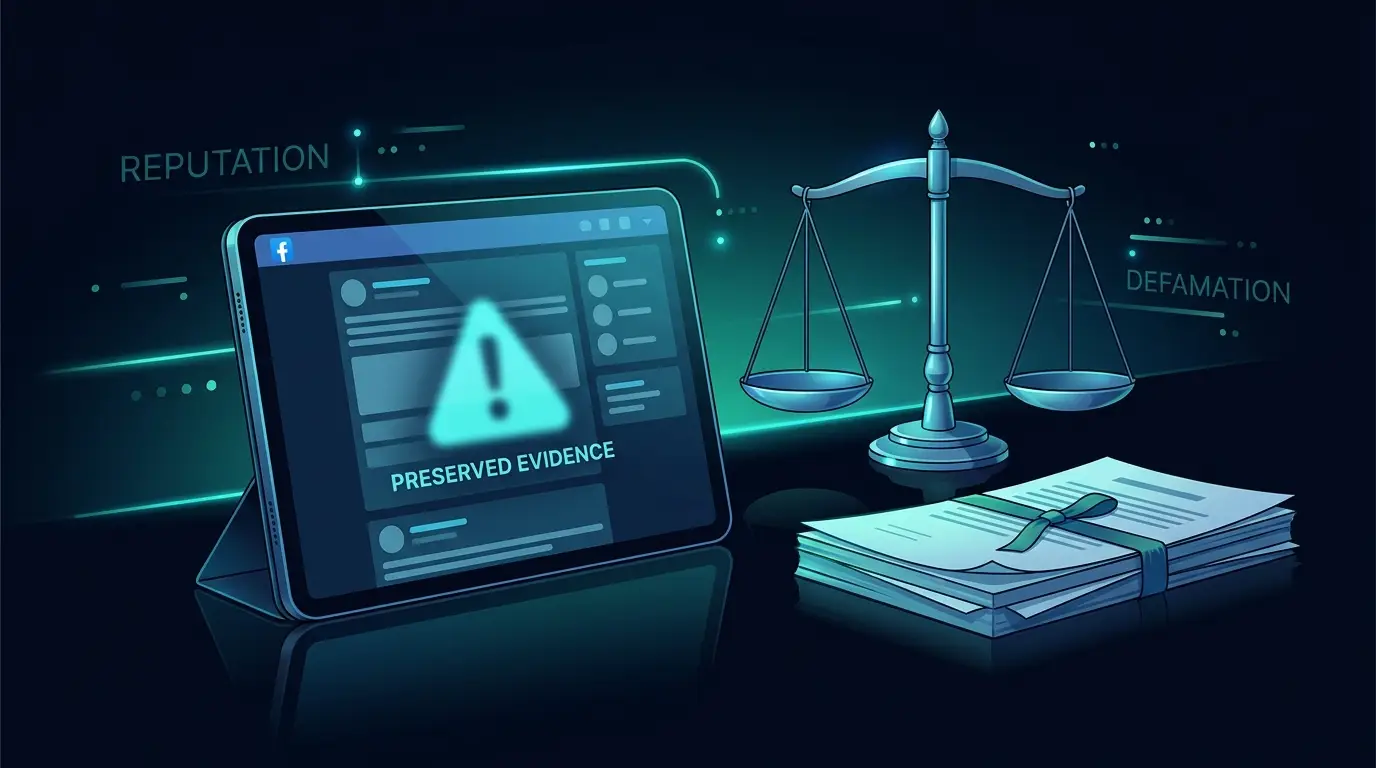
What Counts as Social Media Defamation?
Defamation is a false statement of fact, published to a third party, that causes harm to the reputation of the person or entity it is about. In the context of social platforms, this definition extends across virtually every major network where content can be read by people beyond the original poster.
Online defamation includes false posts on Facebook, Instagram, TikTok, X (formerly Twitter), LinkedIn, Google Reviews, Yelp, Reddit, and any other platform where third parties can read the statement. The reach of these platforms means that a single false claim can travel further and faster than any newspaper article ever could, which is why online defamation claims have grown significantly in number over the past decade.
For a statement to qualify as defamation, several elements generally need to be present:
- The statement must be a claim of fact, not a subjective opinion. Saying "I think this business gives poor service" reads as opinion; saying "this business defrauded me of $10,000" is a factual allegation.
- The statement must be false. True statements, however damaging, are not defamatory.
- The statement must be published to at least one third party who is not the subject.
- The statement must cause identifiable harm: reputational damage, lost business, emotional distress, or other recognized injury, depending on the jurisdiction.
The distinction between libel and slander matters on social media. Libel refers to written or recorded false statements, while slander refers to spoken statements. Social media posts, comments, captions, and video content are typically treated as libel because they are recorded and persist beyond the moment of delivery.
Public figures face a higher burden in defamation claims than private individuals. Under the standard applied in US federal law, a public figure must demonstrate that the defendant acted with actual malice, meaning they knew the statement was false or acted with reckless disregard for its truth or falsity. Private individuals generally face a lower threshold, though the specifics differ by jurisdiction.
Important: This is a general overview only. Defamation law varies significantly across US states, Australian states and territories, UK law, and other jurisdictions. The elements required to establish a claim, who bears the burden of proof, and what remedies are available all differ. Speak with a qualified defamation attorney before taking action based on anything in this article.
Why Preservation Method Matters in Defamation Claims
The core challenge in any online defamation case is that social media content can disappear at any time. The poster can delete a comment or post within minutes of publishing it. A platform can remove content that violates its policies. An account can be deactivated, taking its entire post history with it. Any of these events can happen faster than a subpoena or a court order can be obtained.
Courts require that evidence be authenticated before it can be admitted. Authentication means giving the court sufficient assurance that what you are presenting is the actual post that appeared online, not something altered, fabricated, or taken out of context. This requirement is where many defamation cases run into difficulty, because the most common instinct when you find a defamatory post is to take a screenshot.
A screenshot alone is increasingly challenged in courts. Screenshots can be edited with basic image-editing software that is available to anyone. They do not carry the underlying metadata that would indicate when the capture was taken, from which URL, or by which device. They do not prove the content appeared on the platform at a specific date and time. An opposing party's attorney will often argue that a screenshot could have been fabricated, and without corroborating technical data, that argument can succeed.
Hash-verified forensic captures address this problem. When social media evidence is captured and a SHA-256 cryptographic hash is computed at the moment of collection, the result is a unique fingerprint of the content as it existed at that exact point in time. If the content is later altered in any way, the hash will not match, and the tampering becomes detectable. This is why forensic capture is the gold standard for online defamation evidence collection.
Authentication rules such as Federal Rule of Evidence 901 in US federal courts require a showing that the evidence is what it claims to be before it can be admitted. A hash-verified capture, accompanied by a record of when and how it was made, provides exactly the foundation those rules require. For a detailed look at how chain of custody works for digital evidence, see our guide at social media evidence chain of custody.
What Social Media Content to Collect
When you identify defamatory content online, the instinct is to capture the post itself, but a complete online defamation evidence package requires more than the post in isolation. Courts and attorneys need context, and context lives in the surrounding material.
Here is what to capture for each incident of potential defamation:
- The original defamatory post itself: the full text, any images or videos embedded in it, the date and time it was posted, the account name, and the direct URL to the post.
- Replies, comments, and shares: these establish how widely the false statement spread and how others reacted, which is directly relevant to the damages element of a defamation claim. A post that was seen by five people causes less harm than one that was shared by five hundred.
- The profile page of the poster: the username, display name, profile photo, bio, and follower count at the time of capture. These details help identify who made the statement and give the court a sense of the poster's reach and audience.
- Any prior posts by the same account that show a pattern of targeting the same individual or business. Repeated targeting is relevant to establishing malice and to damages.
- Any posts on other accounts that cite, quote, retweet, or amplify the original defamatory statement. Amplification determines the full scope of harm.
For video defamation on TikTok, Instagram Reels, YouTube, or Facebook, the audio transcript of what was actually said is a critical component of the evidence. A video transcript with timestamps, linked to a hash-verified preserved copy of the video, is far stronger than a paraphrased description of what was said. Courts need to see the exact words, not an approximation.
How to Collect Defamation Social Media Proof
Speed and method are both essential when collecting defamation social media proof. The following steps represent the approach that produces the most defensible evidence package.
Step 1: Do not delay. Social media posts can be deleted within hours of a complaint or legal threat becoming known. The moment you identify potentially defamatory content, begin the collection process. Waiting until you have legal advice before capturing can mean the evidence is already gone by the time you act.
Step 2: Identify every platform where the defamatory content appears. Search for your name, your business name, and common misspellings across Facebook, Instagram, TikTok, X, YouTube, LinkedIn, Google Reviews, and Reddit. Defamatory campaigns frequently spread across multiple platforms simultaneously.
Step 3: Use a forensic capture tool, not screenshots. A proper social media evidence capture preserves the page structure, metadata, the URL, the timestamp at the moment of capture, and applies hash verification to the collected content. This is the difference between evidence that can be authenticated and evidence that will be challenged.
Step 4: Capture the poster's profile page and any related posts that show context, pattern, or escalation. A single post rarely tells the whole story, and a history of similar statements strengthens a damages argument considerably.
Step 5: If videos are involved, ensure AI transcription is run so the exact words spoken are preserved in text form. Video transcripts are essential for defamation claims based on spoken statements in reels, TikToks, or livestreams. For more on how video transcription works in an evidence context, see our guide at TikTok and Instagram transcription.
Step 6: Document your collection process. Record what you captured, when, from which URL, and which tool you used. This documentation becomes part of your chain of custody record and may be needed if someone challenges the authenticity of your evidence.
Step 7: Provide everything to your attorney promptly. An organized, well-documented evidence package allows your attorney to assess the strength of your claim quickly and advise on next steps.
Social Evidence captures entire public profiles including all posts, videos, captions, and comments, applies SHA-256 hash verification to every captured item, and transcribes video content automatically. This makes it well suited for online defamation evidence collection at scale, particularly when the defamatory content appears across multiple posts or an entire account history.
Authenticity: Making Your Evidence Hold Up
Authentication is the process of proving to a court that the evidence you are presenting is genuine and has not been altered since it was collected. For social media evidence in defamation cases, authentication typically requires demonstrating several things: when and how the content was captured, who captured it, that the method of capture was reliable, and that the content has not been changed since the moment of collection.
A hash-verified forensic capture is the gold standard for meeting this requirement. When a SHA-256 hash is computed at the time of collection, any party can re-run the hash against the preserved file at any later date. If the hash matches, the content is provably unchanged. If it does not match, the alteration is detectable. This creates a level of verifiability that no screenshot can match.
Metadata matters too. Captures that include HTTP headers, capture timestamps, and the source URL give courts the contextual proof they need to understand exactly what was collected, from where, and when. This data travels with the evidence rather than existing only in the memory of the person who took the screenshot.
Witness testimony remains part of the authentication picture. The person who captured the evidence may need to attest, via affidavit or in-person testimony, that the capture reflects what they personally observed on the platform at that time. A forensic capture makes this attestation easier and more credible: the witness can point to objective technical data rather than relying solely on their own recollection.
Opposing parties will challenge authenticity whenever they believe they can succeed on that argument, particularly if the evidence was collected poorly. A forensic-grade process substantially reduces that risk. For a detailed discussion of why screenshots frequently fail authentication challenges, see our post at can screenshots be used as evidence in court.
When Deleted Posts Become Critical
The most damaging defamatory content is often deleted quickly. Posters frequently remove statements after receiving a cease-and-desist letter, after a platform flags the content for review, or simply after realizing the post has attracted unwanted attention from the subject. This deletion can happen within hours of the original post going up, and it can happen before the subject of the statement even becomes aware of its existence.
This makes real-time and proactive preservation critical. Preserving defamatory posts while they are still live is the single most important action you can take in a defamation case. Once content is deleted from a platform, even the most sophisticated forensic tools cannot retrieve it from the platform's servers. Only content that was captured while it was publicly accessible can be authenticated and presented as evidence.
If the content is already deleted when you seek to preserve it, your options are limited. Cached versions in Google or Bing search results are short-lived and typically disappear within days or weeks. The Wayback Machine at archive.org provides inconsistent coverage of social media content and its captures are not authenticated in the forensic sense. Evidence that others captured before the deletion may be available, though it carries the same authentication challenges as any screenshot-based evidence.
In some jurisdictions, spoliation rules may come into play if a party deletes evidence after a legal hold is formally in place. However, this requires the legal hold to exist at the time of deletion, which in turn requires litigation to be underway or clearly anticipated. Relying on spoliation doctrine as a fallback is a poor substitute for capturing the content directly while it exists.
The lesson is straightforward: capture first, then consult your attorney. A well-preserved evidence package gives your legal team everything they need. An absence of preserved content leaves your claim without its foundation. Social media legal hold procedures address what happens once litigation is underway, but preserving defamatory posts before a hold is in place is your responsibility from the moment you first see the content.
Working With Your Lawyer
When you bring a defamation matter to an attorney, the quality of your evidence package directly affects how quickly and effectively they can advise you. An organized collection of authenticated evidence is far more useful than a folder of screenshots, a series of phone photos of a screen, or a verbal description of what you saw.
An ideal defamation evidence package contains the following elements for each captured item: the URL where the content was found, the date and time of capture, the hash value computed at capture, the full preserved content including any embedded images or videos, a transcript for any video content, and a clear record of which tool was used and who conducted the capture.
Your attorney will use this package to assess the strength of the defamation claim, advise on jurisdiction, and determine whether the threshold for a viable claim is met. They will also advise on whether to send a cease-and-desist letter, pursue platform removal, or proceed directly to litigation, depending on the specific facts and the jurisdiction's law.
Defamation law differs substantially across jurisdictions. US state law varies considerably, and federal law applies a different standard for public figures than for private individuals. Australian defamation law has its own threshold and defenses, and UK law differs again. What constitutes a defamatory statement, who bears the burden of proof, what defenses are available, and what damages can be recovered all depend on where the claim is brought.
If you are self-represented, many court systems provide procedural guides for small claims or civil defamation proceedings. A well-organized, forensically sound evidence package remains the most important asset you can bring to any proceeding, regardless of whether you have legal representation. Courts assess evidence by its quality and provenance, not by the sophistication of the party presenting it.
Frequently Asked Questions
What social media content qualifies as defamation?
A social media post, comment, video, or story that contains a false statement of fact about an identifiable person or business, published to a third party, and that causes reputational harm can qualify as defamation (libel). Opinions, satire, and true statements generally do not meet the defamation threshold, but the line between fact and opinion is often contested in practice. Consult a defamation attorney for advice on your specific situation.
Can a Facebook post or Instagram comment be used as evidence in court?
Yes. Social media posts are regularly admitted as evidence in defamation cases, provided they are properly authenticated. Hash-verified forensic captures are significantly more robust than screenshots for this purpose, as they carry the metadata and cryptographic verification a court needs to assess authenticity. A post that was captured with SHA-256 hash verification is far harder to challenge than one preserved only as a screenshot.
What is defamation social media proof and how do I get it?
Defamation social media proof is the preserved, authenticated record of the defamatory content: the post itself, associated comments, profile details, timestamps, and any video transcripts. It is collected using forensic capture tools that apply hash verification to every item at the moment of capture. Screenshots and copy-and-paste are not sufficient for this purpose because they lack the metadata and integrity verification courts require.
What if the defamatory post has been deleted?
If the content was deleted before you could capture it, options are limited to cached versions in search engines (which are short-lived), Wayback Machine archives (which offer inconsistent coverage and are not forensically authenticated), or evidence that others captured before the deletion. This is precisely why capturing defamatory content the moment you find it is the most important step in any online defamation claim. Preserving defamatory posts while they are live is far more effective than attempting recovery after deletion.
Are screenshots enough for a defamation case?
Screenshots can be challenged as potentially fabricated or altered, and they typically lack the metadata courts need to authenticate digital evidence. In some low-stakes contexts they may be accepted, but any competent opposing attorney will challenge their authenticity. A hash-verified forensic capture is significantly more defensible and substantially less likely to be excluded. The post at can screenshots be used as evidence in court covers the authentication challenges in detail.
How long do I need to keep social media evidence for a defamation claim?
Retain all captured evidence until the matter is fully resolved, including any appeals. If litigation is anticipated, initiate a legal hold immediately to ensure nothing on your end is deleted or overwritten. The limitation period for defamation varies by jurisdiction: in many US states it is one to two years from publication, while Australian and UK law have their own timelines. Regardless of the applicable limitation period, preserving everything from the moment of capture is the safest approach. Consult your attorney for advice on retention obligations specific to your jurisdiction and circumstances.
Preserve Defamation Evidence Before It Disappears
Social Evidence captures public posts, videos, and profiles with SHA-256 hash verification and automatic video transcription, giving you court-ready online defamation evidence the moment you need it.
Start for free