
What Is Cyberstalking on Social Media?
Cyberstalking is a course of conduct carried out through electronic means, including social media, that causes a reasonable person to feel fear, harassment, or substantial distress. Unlike a single offensive comment, cyberstalking involves repetition, escalation, and a recognizable pattern of behavior aimed at a specific target.
On social media, this pattern can take many forms:
- Repeated unwanted contact: sending messages, commenting on posts, or tagging the target despite being told to stop or after being blocked;
- Monitoring and weaponizing location: reacting to or referencing the target's public check-ins, stories, or tagged locations in ways that demonstrate surveillance;
- Public posting designed to intimidate: posts, videos, or stories that reference the target, their family, their workplace, or their routines without explicit threat but with clear intent to signal "I am watching";
- Impersonation accounts: creating fake profiles using the target's name, photos, or identity to damage their reputation or contact others in their network;
- Coordinated harassment: directing followers or other individuals to pile onto the target through posts, comments, or reports;
- Threats sent privately or publicly: direct messages, story replies, or public posts containing statements that place the target in fear of physical harm.
Social media evidence of these behaviors is what distinguishes a prosecutable cyberstalking case from an unsubstantiated complaint. Without a documented record, the victim's account becomes a credibility contest. With it, the pattern speaks for itself.
The Legal Framework: Federal and State Laws
In the United States, cyberstalking is addressed at both the federal and state levels. Federally, 18 U.S.C. Section 2261A prohibits using the internet or electronic communications to engage in a course of conduct that places a person in reasonable fear of death or serious bodily injury, or causes substantial emotional distress. The statute covers communications directed at the victim and at their immediate family members.
Every US state also has its own harassment, stalking, or cyberstalking statute. The specific elements vary: some require proof of fear of physical harm; others extend to substantial emotional distress. Some states require that the conduct be directed at the victim; others capture surveillance-style conduct even without direct contact. The applicable law depends on where the victim is located, where the perpetrator is located, and sometimes where the conduct occurred, which in online contexts can involve multiple jurisdictions.
For civil remedies, cyberstalking victims can often seek an emergency protective order or restraining order without criminal proceedings, provided the social media evidence meets the court's threshold for demonstrating a pattern of harassment or credible threat. Those thresholds vary by state but generally require something more than isolated incidents, which is why a complete, documented record of all conduct is so important.
Types of Social Media Evidence in Cyberstalking Cases
Not all social media evidence carries equal weight. Understanding which types are most useful, and why, helps prioritize what to collect and preserve.
Public Posts and Stories
Posts, videos, reels, and stories published to a public account are generally the easiest social media evidence to collect, since they do not require account access. A documented record of public posts that reference the target, signal surveillance, or contain threats is directly relevant to establishing the pattern of conduct. Capture these forensically rather than by screenshot, since the post URL, timestamp, and account metadata are all critical to proving the post is real and attributing it to the correct account.
Direct Messages and Comment Threads
Private messages are the most direct form of cyberstalking evidence, particularly where explicit threats or repeated unwanted contact occurred. Unlike public posts, DMs can generally only be captured from within the victim's own account. Use your platform's export or download feature where available, and supplement with documented screenshots that include as much context as possible: the conversation header, account identifier, timestamps, and surrounding messages. Do not edit or delete any messages, even ones you find distressing.
Impersonation and Fake Accounts
Fake profiles created to impersonate the victim or to contact the victim's friends and family without being blocked are a hallmark of sustained cyberstalking. Social media evidence of impersonation accounts includes: the fake profile URL, the profile content (name, photos, bio), any messages sent from the fake account, and the timing of the account's creation relative to when the victim blocked or reported the perpetrator. Capturing a fake account forensically before the platform removes it is critical, since impersonation reports typically result in rapid takedowns.
Follower and Engagement Patterns
In some cases, the evidence of stalking is behavioral rather than textual: the perpetrator creates new accounts after being blocked, follows the same mutual accounts, or engages with the victim's tagged content through third-party accounts. Documenting this pattern, including the timing and account details, helps establish intent and persistence that would not be obvious from any single piece of content.
Location and Check-in References
Posts or stories that reference the victim's location, workplace, neighborhood, or routine without that information being shared publicly can demonstrate that the perpetrator has been physically monitoring the victim in addition to conducting online surveillance. These posts often contain time-sensitive information that connects them to specific events in the victim's offline life, which is powerful corroborating evidence.
Why Pattern Evidence Matters More Than Single Incidents
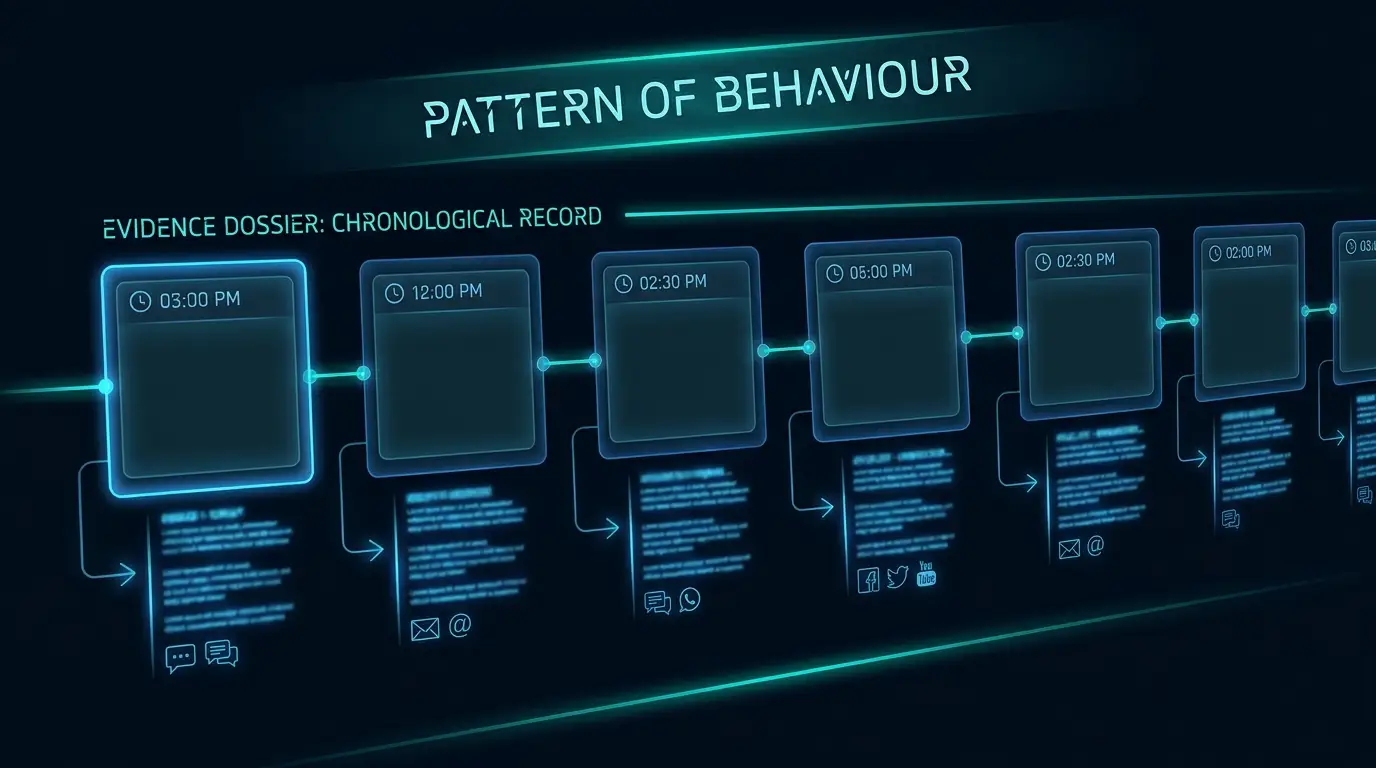
One of the most important concepts in cyberstalking cases is the distinction between isolated incidents and a pattern of conduct. A single threatening message, while alarming, may not meet the legal threshold for cyberstalking on its own. A documented series of contacts, escalating in frequency or intensity, that together demonstrate a sustained course of conduct targeting the same victim, is a much stronger evidentiary foundation.
This has a direct implication for how you collect social media evidence. Collecting only the most severe or explicit content, while ignoring the surrounding context, understates the pattern. A judge evaluating whether to grant a protective order, or a prosecutor deciding whether to charge, needs to see the full sequence: when contact began, how it has escalated, what the victim did in response (blocking, reporting, requesting the person stop), and how the perpetrator adapted (creating new accounts, using mutual contacts, shifting to public posts).
As our overview of social media evidence chain of custody explains, the chronological integrity of a social media evidence record, its ability to show what happened in what order, is as important as the individual items it contains.
The Deletion Problem: Why You Must Act Quickly
Cyberstalking perpetrators delete evidence. This happens in several predictable patterns:
- Reactive deletion: perpetrators delete content when they realize the victim has reported it, law enforcement has been contacted, or an attorney has sent a demand;
- Platform removals: platforms act on harassment reports by removing content, which can happen within hours, sometimes before the victim has captured it;
- Story expiry: on Instagram and Snapchat, stories vanish after 24 hours regardless of any action by the perpetrator;
- Account deletion: perpetrators may delete entire accounts when they believe investigation is imminent, taking all post history with them.
The window between when social media evidence of cyberstalking exists on a platform and when it is gone can be measured in hours. This is why preservation tools matter so much in these cases. A forensic social media capture platform can archive an account in minutes, creating a timestamped, hash-verified record before the perpetrator or the platform removes anything. Once content is deleted and unpreserved, recovery options are limited to law enforcement subpoenas (which may or may not produce results depending on what the platform retains) or forensic recovery of device data.
The guide on preserving TikTok evidence before it is deleted covers the time-sensitivity of social media content in detail, and the same principles apply across platforms in cyberstalking contexts.
How to Preserve Cyberstalking Evidence on Social Media
A defensible social media evidence record for a cyberstalking case should contain the following for each piece of conduct:
Step 1: Capture Public Content Forensically
For any public posts, profiles, or stories related to the cyberstalking, use a forensic social media capture platform rather than screenshots. A forensic capture preserves the post URL, platform-native post ID, account metadata, publication timestamp, and generates a SHA-256 hash of the content at the time of collection. This hash is a tamper-evident fingerprint: if the perpetrator later claims a post was altered before you submitted it as evidence, the hash disproves that claim.
Platforms like Social Evidence are used by legal professionals and investigators for exactly this purpose: enter the perpetrator's public account username, and the platform archives every post, story, and video with full forensic integrity. For cyberstalking cases involving ongoing public posting, scheduled or recurring capture is particularly valuable because it automatically documents new conduct as it occurs.
Step 2: Document Direct Messages and Private Content
For private messages, start by using your platform's built-in export or data download feature. Most major platforms including Instagram, Facebook, Snapchat, and X (formerly Twitter) offer some form of data export that includes message history with timestamps. Download this immediately and store the export files securely.
Supplement with screenshots that include the conversation header, the sender's account identifier, and visible timestamps. Do not crop screenshots to remove context. Collect the full thread, not just individual messages, since the sequence and the victim's responses are part of the evidence of continued unwanted contact.
Step 3: Create a Chronological Evidence Log
Maintain a contemporaneous log of all incidents. For each entry, record: the date and time, the platform, the account involved (including the account's username and URL at the time of the incident), a brief description of what occurred, what was captured, and what action (if any) was taken, such as reporting the content or requesting it stop. This log becomes a crucial document when presenting the pattern of conduct to law enforcement or an attorney.
Step 4: Preserve Evidence of Your Own Responses
Preserve any messages in which you told the perpetrator to stop, blocked or reported the account, or otherwise communicated that contact was unwanted. These records are important because they demonstrate that the perpetrator continued the conduct with knowledge that it was unwelcome, which is relevant to the intent elements of many cyberstalking statutes.
Step 5: Do Not Delete Anything
It can be deeply unpleasant to retain access to threatening or harassing messages, but deleting them before they are properly preserved destroys evidence you will need. If having the content visible is distressing, preserve it through the forensic and export methods above first, then archive or hide it locally. Never delete messages that may be relevant to a future legal action.
Working with Law Enforcement and Attorneys
Bringing an organized, documented social media evidence record to law enforcement significantly improves the likelihood of an actionable response. Agencies that might decline to act on a verbal account of harassment often engage more seriously when presented with a chronological record of documented conduct, account identifiers, and preserved content with timestamps.
When meeting with investigators or filing a report, bring:
- A printed or digital summary of the evidence log in chronological order;
- The URL and username of every account involved (perpetrator's primary account and any alternate or fake accounts);
- Copies of the forensically captured posts or the platform data export;
- Screenshots of direct messages with the full conversation thread visible;
- Any prior communications or responses that show the conduct was unwanted.
If local law enforcement is unresponsive, options include filing a report with a state attorney general's cybercrime unit, contacting the FBI Internet Crime Complaint Center (IC3) for federal matters, consulting a private attorney about civil remedies such as a restraining order or harassment injunction, or working with a private investigator who specializes in online harassment documentation. The guide on social media evidence in law enforcement criminal investigations provides broader context on how agencies approach digital evidence.
What Courts Assess When Evaluating Online Stalking Evidence
Courts evaluating social media evidence in cyberstalking cases assess several dimensions:
Attribution
Can the conduct be connected to the perpetrator? Social media accounts are not always used under real names. Evidence that helps with attribution includes: the account's connection to the perpetrator's known contact details, other accounts they control, content that only the perpetrator would know (such as references to private information), and IP address or device data that law enforcement may be able to obtain through platform subpoenas.
Authenticity
Courts routinely question whether social media evidence has been fabricated or altered. Forensically captured content with SHA-256 hashes, publication timestamps, and full account metadata is far more resistant to authenticity challenges than unverified screenshots. The stronger your authenticity record, the less time gets spent arguing about whether the evidence is real rather than what it means.
Pattern and Intent
As noted earlier, pattern matters. Courts look at the timeline of conduct, the frequency of contact, whether the conduct escalated after the victim took steps to stop it, and what the perpetrator knew about the victim's reaction. A well-organized chronological record makes this pattern legible without requiring the court to do the analytical work.
Credible Fear
Many cyberstalking statutes require that the conduct caused a reasonable person to feel fear or substantial distress. The social media evidence itself, particularly threats, surveillance demonstrations, and escalating conduct, often provides the foundation for this element. Contemporaneous records of how the victim responded, steps they took to avoid contact, changes they made to their routines, can corroborate that the fear was real and reasonable.
For cases involving protective orders specifically, the evidence assessment process is similar, and the guide on social media evidence in protection order applications covers that context in detail.
Key principle: the goal of preserving social media evidence in cyberstalking cases is to make the pattern undeniable. A perpetrator who deletes posts is trying to erase that pattern. Forensic capture preserves it before they can.
Frequently Asked Questions
What counts as cyberstalking on social media?
Cyberstalking generally involves a repeated course of conduct online that causes a reasonable person to feel fear or substantial emotional distress. On social media, this includes repeated unwanted contact after being asked to stop, posting content designed to intimidate the target, creating fake profiles to circumvent blocks, directing harassment from third parties, and sending threats through direct messages or public posts. A single incident is typically not enough; prosecutors and courts look for a pattern.
How should I preserve social media evidence of cyberstalking?
Use a forensic social media capture platform for public accounts: it archives content with metadata, timestamps, and SHA-256 hashes. For direct messages, use your platform's data export feature and supplement with full-thread screenshots. Maintain a chronological incident log and do not delete any messages, even distressing ones, until they have been properly preserved.
Will law enforcement take cyberstalking complaints seriously?
Response varies by jurisdiction and agency, but organized, documented evidence significantly improves outcomes. Bringing a well-preserved chronological record with account identifiers, forensically captured posts, and a clear timeline of escalating conduct is more effective than a verbal account alone. If local police are unresponsive, specialist cybercrime units, the FBI IC3, or a private attorney pursuing civil remedies are alternative paths.
Can deleted posts still be used as cyberstalking evidence?
If captured forensically before deletion, yes. A preserved, hash-verified copy is valid evidence even after the original is gone. If the post was not captured before deletion, options are limited to law enforcement subpoenas for platform data, cached or indexed copies, or records held by other witnesses who saw the content. This is why early capture is critical in cyberstalking cases.
What is the federal cyberstalking law in the US?
18 U.S.C. Section 2261A is the principal federal statute. It prohibits using electronic communication to place a person in reasonable fear of death or serious bodily injury, or to cause substantial emotional distress. Most states also have their own statutes with varying elements. This article is general information, not legal advice; consult a qualified attorney about your situation.
Should I block the cyberstalker on social media?
Blocking is a reasonable safety step and is generally advisable when recommended by law enforcement or counsel. Be aware that blocking may limit your ability to monitor and preserve new public conduct posted by that account. A forensic social media capture platform can continue archiving a public account even after you block it on the platform, so you can take the safety step without losing the ability to document ongoing behavior.
Preserve Cyberstalking Evidence Before It Disappears
Social Evidence archives public social media accounts with SHA-256 hash verification, full metadata, and a documented chain of custody. Used by legal professionals and law enforcement to preserve cyberstalking social media proof before perpetrators delete it.
Start for free