Why Social Media Is a Goldmine for Asset Tracing
Traditional asset tracing relies on land registry searches, corporate filings, bank subpoenas, and forensic accounting. Those tools are powerful but slow, expensive, and dependent on paper trails that a determined person can conceal. Social media introduces something fundamentally different: a self-maintained public record of how someone actually lives.
People post what they buy. They tag where they travel. They photograph what they own. They announce business ventures, tag friends at restaurants, check in at hotels, and geotag images from properties they may not have disclosed. The impulse to share is strong enough that even people actively concealing assets from courts or creditors routinely undermine themselves by posting publicly.
For investigators, that impulse creates a searchable archive of lifestyle evidence. A single post picturing an expensive watch, a new vehicle in a driveway, or a boarding pass to an international destination can open an entirely new line of inquiry, directing attorneys toward subpoenas they would never have known to request and giving forensic accountants the targets they need.
Social media evidence asset tracing is now a standard first step in financial investigations precisely because it is fast, relatively inexpensive, and frequently decisive. Before spending weeks on formal discovery, experienced practitioners routinely spend a few hours reviewing a subject's public social media presence. What they find often shapes the entire strategy.
The information gap between a subject's sworn financial disclosure and their curated social media persona can be enormous. That gap is where investigations begin.
What Asset Tracers Look for on Social Media
Not every post is useful. Asset tracers are looking for content that creates a discrepancy between a subject's stated financial position and their apparent means or that points toward specific assets worth investigating further.
Luxury Goods and Consumer Spending
Watches, jewellery, designer clothing, handbags, and electronics are frequently photographed and often worth significant sums. A post showing a recently purchased luxury item, even in the background of what appears to be an unrelated photo, can contradict a claim of financial hardship. These items are also often gifted to avoid disclosure, making their appearance in posts all the more relevant.
Real Estate and Property
Check-ins at undisclosed addresses, photographs taken inside unfamiliar properties, and geotagged images can all indicate ownership or occupation of real estate not reflected in financial statements. Investigators cross-reference locations identified from posts against land registry records, sometimes finding properties held in the names of companies or relatives.
Vehicles
Vehicles are among the most commonly undisclosed assets in financial proceedings. Licence plates, make and model details visible in photographs, and posts tagging car dealerships or vehicle services give investigators specific targets to search in motor vehicle registries.
Travel and Hospitality
Business-class flights, resort stays, and private villa check-ins are expensive. Posts and stories showing high-end travel, particularly frequent international travel, are strong indicators of disposable income inconsistent with a declared insolvency position.
Business Affiliations and Income Streams
Business announcements, partnership posts, product launches, and professional milestones published on social media often predate or contradict corporate filings. A person declaring bankruptcy while publicly announcing a new business venture presents an obvious discrepancy. Sponsored posts and affiliate marketing content on platforms like TikTok and YouTube also constitute income that may not be declared.
Gifted and Transferred Assets
Assets transferred to family members or friends to put them beyond the reach of creditors sometimes resurface in those recipients' social media posts. A spouse's or parent's Instagram feed may inadvertently document the asset the subject claims no longer to own.
Common Scenarios Where Social Media Asset Tracing Is Used
Social media evidence asset tracing appears across a wide range of legal and investigative contexts. The underlying logic is the same in each: sworn financial disclosure is contradicted or supplemented by public behaviour.
Divorce and Family Law Proceedings
Financial disclosure is mandatory in most divorce and property settlement proceedings, yet concealment of assets is common. Social media evidence of hidden assets in divorce matters because one party may claim their business income has dropped or their personal assets are minimal, while simultaneously posting evidence of spending, investment, or ownership that directly contradicts those claims. Family courts have become increasingly receptive to social media evidence for exactly this reason.
Bankruptcy Fraud
Individuals and companies filing for bankruptcy are required to disclose all assets to creditors and the court. Fraudulent omission is a serious offence, and social media evidence in bankruptcy fraud investigations is used to identify assets that never appeared in the schedule of disclosures. A business owner who files for bankruptcy while continuing to operate an undisclosed related entity, or who transfers assets before filing, may document either activity publicly without realising the implications.
Judgment Enforcement
Winning a judgment is one thing. Collecting it is another. Judgment creditors regularly struggle to locate assets belonging to debtors who claim to have nothing. Social media evidence provides leads that can be converted into formal enforcement steps: locating property to register a charging order against, identifying bank accounts through business posts, or finding vehicles to seize.
Financial Fraud and Commercial Investigations
Financial fraud social media asset tracing is particularly relevant in fraud recovery matters, where victims or their lawyers are trying to locate assets acquired through fraud. A fraudster who spent the proceeds on visible lifestyle items, property, or investments will often have documented that spending publicly.
Family Court Financial Disputes and Child Support
Income for child support purposes is sometimes understated by self-employed parties. Social media posts showing business activity, brand partnerships, event appearances, or professional engagements can help establish a more accurate picture of earning capacity than the income figures a party is willing to declare.
Platforms and Content Types Most Useful for Asset Tracing
Not all platforms are equally useful. The table below summarises what asset tracers typically find on each major platform and how valuable that content tends to be for investigations.
| Platform | Typical Asset Signals | Usefulness for Asset Tracing |
|---|---|---|
| Luxury goods, travel, vehicles, real estate interiors, geotagged locations, sponsored posts, lifestyle spending | Very high. The dominant platform for lifestyle evidence. Stories and reels require timely capture before expiry. | |
| Check-ins, property tags, event attendance, business pages, tagged photos from others, group memberships | High. Check-in history and tagged photos from third parties are particularly valuable and often overlooked by subjects managing their own profile. | |
| TikTok | Shopping hauls, luxury unboxings, travel vlogs, income disclosures in sponsored content, business operations footage | Moderate to high. Growing value as an income evidence source; creator monetisation and brand deals are frequently documented openly. |
| Employment history, business affiliations, directorships, professional announcements, consulting roles, board positions | High for business structure evidence. Contradicts claims of unemployment or dissolved business interests. Connecting undisclosed entities to a subject is a common finding. | |
| YouTube | Channel monetisation, subscriber milestones, business vlogs, brand sponsorships, equipment and property visible in production | Moderate. Useful for establishing undeclared income streams. Long-form content often contains incidental disclosures about assets, travel, and spending habits. |
| X (Twitter) | Business announcements, investment commentary, financial opinions inconsistent with claimed poverty, conference attendance | Moderate. Older posts and retweets build a timeline that can contradict later claims. Less visual but useful for professional network mapping. |
A thorough approach to locating hidden assets via social media covers multiple platforms simultaneously. Subjects often maintain different personas across platforms, sharing lifestyle content on Instagram while discussing business on LinkedIn and making financial commentary on X. Taken together, those accounts create a far richer picture than any one platform alone.
Investigator's note: Third-party content is often more revealing than the subject's own posts. Friends, family members, and business associates tagging the subject in photos or check-ins can document assets the subject has carefully kept off their own profile.
How to Collect and Preserve Social Media Evidence for Asset Tracing
Finding relevant content is only half the task. Social media posts can be deleted in seconds, platforms can make content temporarily unavailable, and accounts can go private. Evidence that exists today may not exist tomorrow. Proper collection and preservation is what converts a discovery into something that can actually be used.
Why Screenshots Are Not Enough
Screenshots are the most common collection method and the most commonly challenged. A screenshot shows what was on a screen at some point, but it contains no embedded metadata about when the capture was made, from where, or by what process. It can be altered in image editing software without leaving obvious traces. Courts in many jurisdictions now expect more, and opposing counsel will raise authenticity challenges against screenshot-only evidence as a matter of routine.
What Forensic Capture Requires
Court-grade social media evidence collection involves several elements working together:
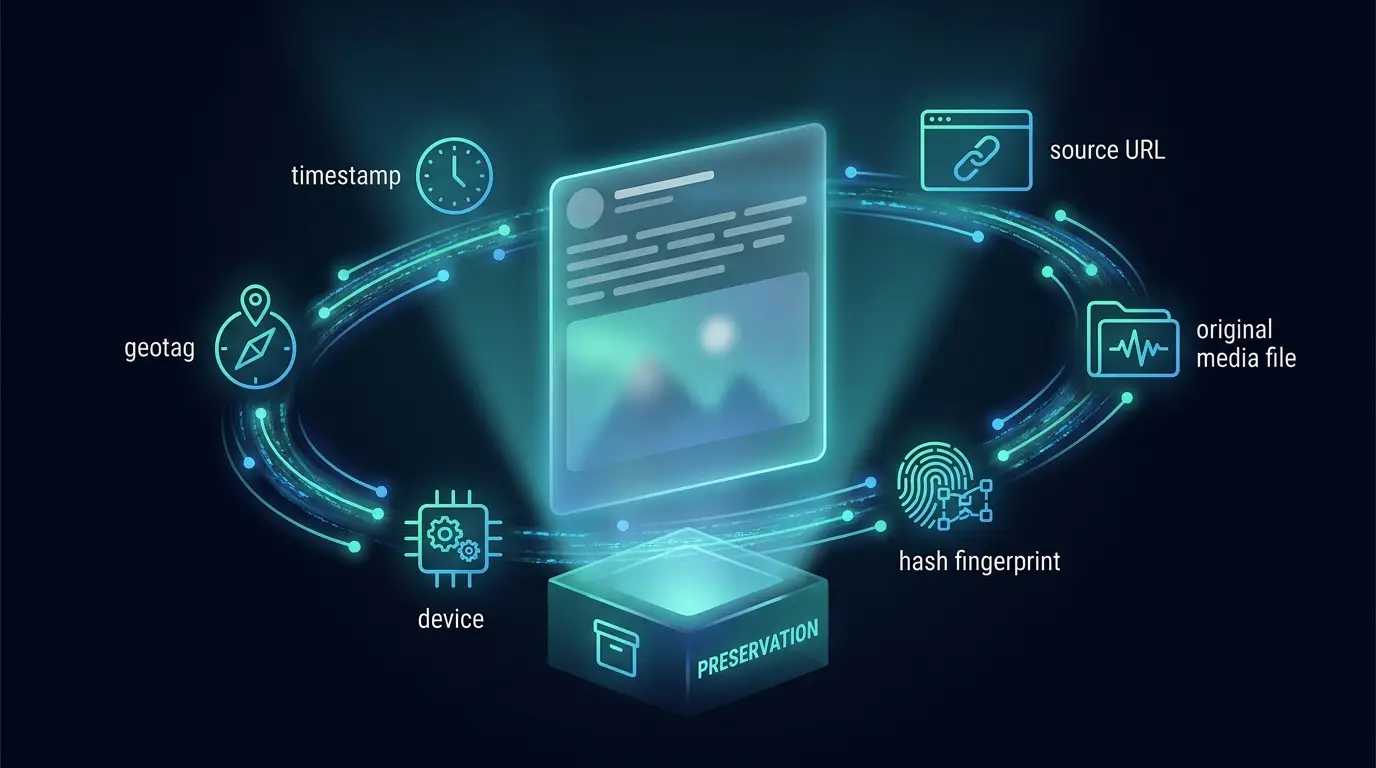
- Full-page capture: the complete post or profile as rendered in a browser, not a cropped image, including timestamps, engagement metrics, and surrounding context;
- Embedded metadata: capture date, time (with timezone), the URL of the captured page, and the IP address from which capture was made;
- Cryptographic hashing: a SHA-256 hash of the captured file, generated at the moment of collection, so any subsequent alteration can be detected;
- Chain of custody documentation: a record of who captured the evidence, when, using what process, and how it has been stored and transmitted since;
- Continuous monitoring: for active investigations, an ongoing capture process ensures that new posts are collected and that deleted content is already preserved before removal.
For guidance on the documentation requirements, see our detailed article on maintaining chain of custody for social media evidence.
Timing Is Critical
Instagram stories disappear after 24 hours. Posts can be deleted at any time. A subject who becomes aware of an investigation will often scrub their public profiles quickly. Investigators who wait until formal discovery to collect social media evidence routinely find that the most incriminating content has already been removed. Preserving content early, even before it is clear which posts will matter most, is a standard practice for this reason.
Forensic platforms that offer account-level monitoring rather than single-post capture are significantly more effective here: they capture new content as it appears and retain it even if the subject later deletes it, creating a continuously updated archive of the subject's public activity.
Turning Social Media Findings into Courtroom Evidence
Evidence that convinces an investigator is not automatically evidence that convinces a court. Moving from a social media finding to an admissible exhibit requires several additional steps.
Authentication
The fundamental question a court asks is: is this evidence what you say it is? A photograph captured with proper metadata, a verifiable hash, and a documented collection process is straightforward to authenticate. A screenshot with none of those attributes invites challenge. For a thorough discussion of what authentication requires, see our guide on authenticating social media evidence for court.
Corroborating Documentary Evidence
Social media evidence rarely stands alone in asset tracing matters. A photograph of an undisclosed vehicle is a lead, not a conclusion. That photograph, combined with a motor vehicle registry search confirming ownership and a financial record showing the purchase price, becomes compelling evidence. The strength of social media evidence in financial proceedings comes from its ability to direct formal discovery toward productive targets, not from replacing documentary proof altogether.
Investigators use social media findings to know which registry searches to run, which companies to look up, which bank accounts to subpoena, and which witnesses to question. The social media post opens the door; the corroborating records walk through it.
Expert Evidence and Platform Records
In complex matters, expert testimony from a digital forensics specialist may be necessary to explain the collection methodology and vouch for the integrity of the evidence. In some cases, formal legal process directed at the platform itself, such as a subpoena for account records, can produce metadata and deletion logs that further authenticate what was publicly visible.
Using a forensic collection platform rather than manual methods significantly reduces the burden at the authentication stage because the methodology is already documented, repeatable, and designed to meet evidentiary standards.
Limits and Legal Boundaries of Social Media Asset Tracing
Social media evidence asset tracing is a powerful tool with real constraints. Understanding those constraints is as important as knowing the capabilities.
Public Content Only
The legal foundation for social media evidence collection rests on the public nature of the content. A post that anyone with an internet connection can view without logging in or bypassing any restriction is genuinely public. Accessing private accounts, using fake profiles to bypass privacy settings, accessing a subject's accounts without authorisation, or inducing someone to share private content deceptively are all legally problematic and potentially unlawful under computer fraud, wiretapping, and privacy laws in most jurisdictions. Evidence obtained through those means is also likely to be excluded from proceedings and may expose the collector to civil or criminal liability.
The threshold between public and private is not always obvious. Accounts set to "friends only" or "followers only" are private in the relevant sense, even if the subject has hundreds of followers. When in doubt, consult a lawyer before attempting to access content you cannot view without special access.
Surveillance and Stalking Laws
Even for public content, the manner of collection matters in some jurisdictions. Laws governing surveillance, stalking, and harassment can be engaged by systematic monitoring of an individual's activities, even where those activities take place in public view. Professional investigators operating under licence and legal practitioners collecting evidence under formal process are generally on firm ground, but private individuals conducting their own investigations should take advice before undertaking sustained monitoring campaigns.
Jurisdictional Variations
Evidence law and privacy law both vary significantly across jurisdictions. What is admissible in a US federal court, an Australian family court, or a UK commercial court is not identical, and the rules about how evidence must be collected to be usable differ too. Investigators working across borders should take jurisdiction-specific advice rather than assuming that a collection method that works in one country will be accepted in another.
Social Media Evidence as a Lead, Not a Verdict
Even strong social media evidence requires corroboration. A photograph showing someone with what appears to be an expensive watch proves the watch was present at one moment. It does not prove ownership, value, or when it was acquired. Social media findings are starting points that direct formal investigation rather than endpoints that replace it. Treating them as conclusive without corroboration is a strategic mistake that opposing counsel will exploit.
Frequently Asked Questions
Can social media posts really be used to locate hidden assets?
Yes. Courts in the US, UK, Australia, and other common law jurisdictions have accepted social media posts as evidence of undisclosed assets and lifestyle inconsistencies. Photographs of luxury goods, check-ins at properties, and public business announcements can all contradict financial disclosures. The key requirement is that the content is forensically captured with verifiable timestamps and metadata before it can be deleted.
Is it legal to use someone's public social media posts as evidence in asset tracing?
Generally yes, for content posted publicly without any access restriction. Publicly shared posts, photos, check-ins, and videos can be lawfully collected and used in civil and family court proceedings. Accessing private accounts, bypassing privacy settings, or using fake profiles to view restricted content crosses into legally problematic territory. When in doubt, consult a lawyer familiar with evidence law in your jurisdiction.
What platforms are most useful for asset tracing investigations?
Instagram is particularly valuable for lifestyle evidence: luxury goods, travel, vehicles, and real estate regularly appear in posts and stories. Facebook check-ins and photo tags can place individuals at undisclosed properties. LinkedIn reveals employment history and business affiliations that may not appear in financial disclosures. TikTok and YouTube can expose income streams through sponsored content and brand partnerships. A thorough investigation typically covers multiple platforms.
How do I preserve social media evidence so it holds up in court?
Screenshots are rarely sufficient because they can be altered and lack metadata. Court-admissible preservation requires a forensic capture tool that records the full page with embedded metadata, a cryptographic hash (SHA-256) of the captured content, a verifiable timestamp from capture, and a documented chain of custody. Platforms like socialmediaevidence.com produce evidence packages that meet these requirements automatically.
What if the person deletes their posts before I can capture them?
Once content is deleted, it is typically gone unless your collection tool had already captured it. This is why continuous monitoring matters in active investigations: setting up an ongoing archive of a subject's public profiles means new posts are captured as they appear, and evidence is not lost if the subject deletes content later. Forensic platforms that offer account monitoring rather than one-off capture are significantly more effective for this reason.
How does social media evidence fit alongside other asset tracing methods?
Social media evidence works best as a complement to traditional financial investigation tools: land registry searches, corporate records, bank subpoenas, and forensic accounting. A social media post does not prove ownership of an asset by itself, but it can direct investigators toward assets worth subpoenaing records for, contradict sworn disclosures, and strengthen the overall evidentiary picture when documentary corroboration is obtained.
Find Hidden Assets. Build Your Case.
Social Media Evidence forensically captures and preserves social media profiles, posts, and videos with SHA-256 hash verification. Turn public lifestyle posts into court-ready asset tracing evidence trusted by investigators and attorneys.
Start for free