Why Everyone Defaults to Screenshots
Screenshots require nothing: no account, no tool, no training. You see something on a screen, press a button, and have an image. For personal memory, quick notes, or sharing context with a colleague, that is perfectly adequate.
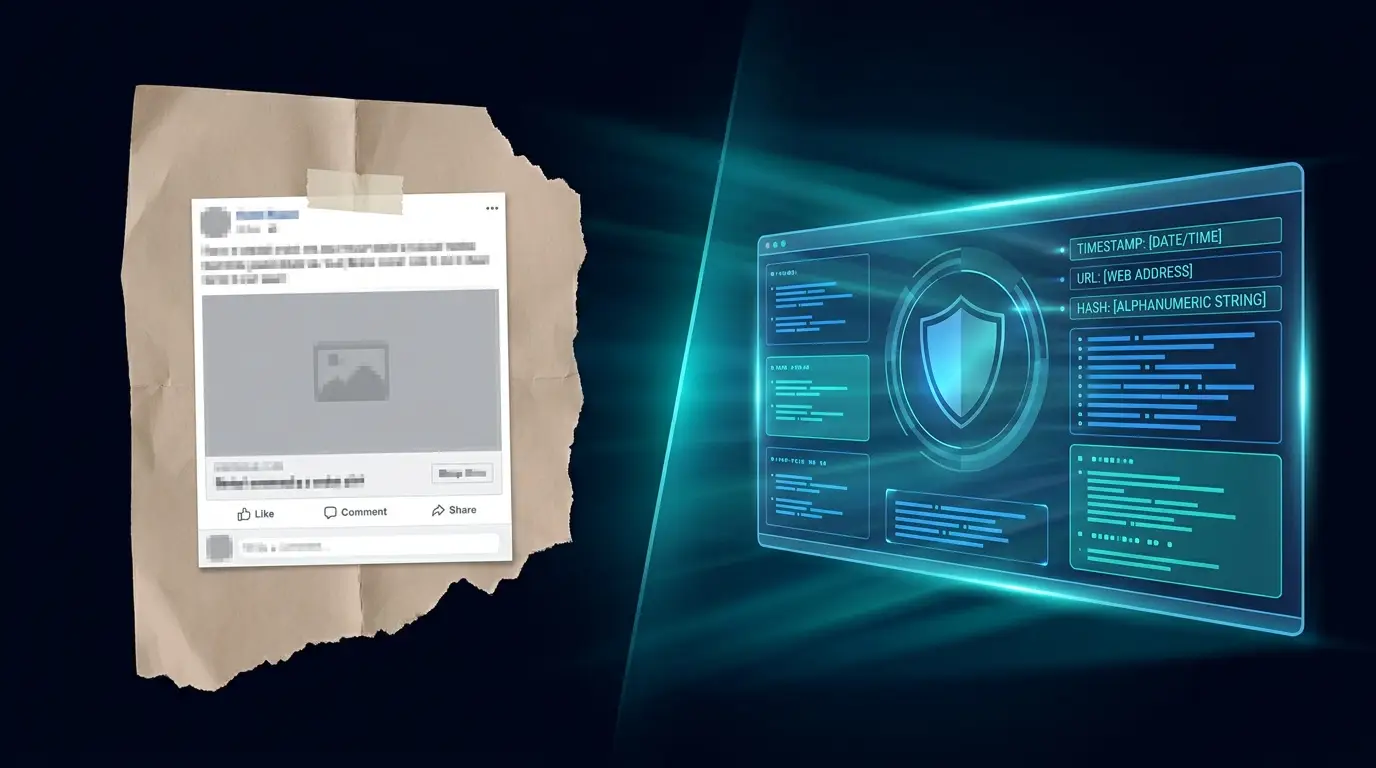
The problem is that screenshots carry almost no information about where they came from, when the content was actually posted, or whether the image has been altered since capture. That context is invisible to the viewer and absent from the file itself. In casual use, nobody needs it. In adversarial proceedings, it is everything.
Legal teams, insurers, investigators, and HR departments who start with screenshots typically discover this problem at the worst possible moment: when the opposing party challenges the evidence. By then, the original post may be gone and the window for proper social media capture has closed.
The Five Problems with Screenshot Evidence
1. Screenshots Are Trivially Easy to Manipulate
A screenshot is a plain image file. Changing the text in a screenshot, altering a timestamp, swapping a username, or adjusting a like count takes seconds with any image editor and is undetectable to the naked eye. Courts and opposing counsel are well aware of this. In any contested proceeding, a screenshot alone invites a challenge that the image was doctored, and there is no reliable way to refute that challenge using the screenshot itself.
This is not a hypothetical problem. Fabricated screenshot evidence has appeared in family law cases, defamation suits, and insurance fraud disputes. Courts have seen enough of it that screenshot-only evidence is viewed with growing skepticism wherever the stakes are high.
2. Screenshots Capture No Metadata
A screenshot records what was visible on your screen at the moment you pressed the button. It does not record the URL of the post, the underlying post ID, the account's unique identifier, the date the post was originally published to the platform, or the time at which you captured it. All of that information exists on the platform; none of it travels with the screenshot file.
When authentication is contested, this metadata is what proves the content is genuine. Without it, the best you can offer is "I saw this on my screen." That is not the same as proving the post existed, was published by a specific account, and has not been altered.
3. Screenshots Provide No Chain of Custody
Even if a screenshot is accurate, there is no audit trail connecting it to the original post. Who took the screenshot? On what device? Was it emailed, uploaded, cropped, or converted between formats before reaching you? Each step introduces potential for alteration and a new gap in provenance. As our in-depth guide on social media evidence chain of custody explains, this documented record of who collected evidence and how it was handled is precisely what courts expect, and it simply cannot be reconstructed from a screenshot after the fact.
4. Screenshots Miss Critical Context
A post screenshot captures what fits on your screen. It may cut off long comment threads, miss earlier replies that explain a later statement, omit the profile bio that establishes who the account belongs to, or fail to include linked media. Partial screenshots are a gift to opposing counsel: they allow the argument that context was cherry-picked or that the full picture tells a different story.
5. Deleted Content Cannot Be Verified from a Screenshot Alone
If the original post is deleted after you take a screenshot, you have an image and nothing else. You cannot return to the platform to verify the post existed, retrieve the metadata, or confirm the account details. Platforms do not preserve deleted content for third parties. If the screenshot is later challenged and the post is gone, you are left with an unverifiable image of content that no longer exists. As our guide on the top mistakes investigators make notes, relying on screenshots instead of forensic capture is one of the most common and most damaging errors in digital evidence collection.
What Is Forensic Social Media Capture?
Forensic social media capture is a structured process for collecting social media content in a way that preserves authenticity, creates a verifiable record, and produces output that can be authenticated under the rules of evidence. Where a screenshot is a passive image of a screen, forensic social media capture is an active, documented collection of the underlying content and its provenance.
The key difference is what gets recorded alongside the visible content. A forensic social media capture platform collects not just what the post says, but everything needed to prove the post is real: the URL, the platform metadata, the account details, the timestamp of collection, and a cryptographic hash of the captured content. That hash, typically SHA-256, is a fingerprint of the data at the moment of capture. If a single character changes later, the hash changes too, making any tampering immediately detectable.
Platforms built for this purpose, like Social Evidence, automate the entire collection: you enter a public username or URL, and the platform archives the content with all metadata attached, generates hashes for every item, timestamps everything at collection, and produces an exportable evidence package. The result is a documented, verifiable record of what was on the platform and when, not just what appeared on a screen.
Side-by-Side Comparison: Screenshots vs Forensic Capture
| Feature | Screenshot | Forensic Social Media Capture |
|---|---|---|
| Captures visible content | Yes | Yes |
| Records post URL and post ID | No | Yes |
| Records platform-native timestamp | No | Yes |
| Records account metadata | No | Yes |
| Records collector identity and time | No | Yes |
| SHA-256 hash verification | No | Yes |
| Captures full comment threads | Partial (visible only) | Yes, complete at time of capture |
| Captures video with metadata | Image of one frame only | Full video file with hash |
| Tamper-evident | No | Yes |
| Court-ready chain of custody | No | Yes |
| Works for deleted content after the fact | No | No (capture before deletion) |
| Cost | Free | Paid (varies by platform) |
How Courts View the Difference
In the United States, Federal Rule of Evidence 901 requires that evidence be authenticated: the proponent must produce enough evidence to support a finding that the item is what it is claimed to be. For social media content, authentication typically requires showing that the post came from the claimed account, that it has not been altered, and that the metadata is consistent with the content's claimed origin.
Courts have accepted screenshots in some cases and rejected them in others. The common thread in rejections is the absence of corroborating evidence to rule out fabrication. When a screenshot is the only evidence and the opposing party denies the post, there is often nothing to break the tie. Forensic social media capture sidesteps that problem entirely by building authentication into the collection process itself.
As our overview of social media court evidence admissibility explains, authentication challenges are the single most common reason social media evidence is excluded or discounted. The gap between "we have a screenshot" and "we have a forensically captured, hash-verified record" maps almost directly onto the gap between evidence that survives a challenge and evidence that does not.
The practical test: if opposing counsel said "this screenshot is fabricated," what would you use to prove it is not? If the honest answer is "nothing," you needed forensic capture from the start.
When Each Method Is the Right Tool
Screenshots Are Fine When:
- You need a quick visual reference for internal review, not evidence;
- The matter is unlikely to become contested or litigated;
- You are supplementing forensic capture with a visual aid, not replacing it;
- The other party is not contesting the existence or content of the post;
- You are sharing context with a colleague who simply needs to see what a post looks like.
Forensic Social Media Capture Is Required When:
- The content will or may be submitted as evidence in any legal proceeding;
- You are documenting content for an insurance investigation or regulatory inquiry;
- The account owner may delete the content before proceedings conclude;
- You are building a case where authenticity will be contested;
- You need to capture an entire account's history, not just individual posts;
- You work in law enforcement, legal services, insurance, or investigations as a profession;
- The content includes video, which a screenshot cannot adequately preserve.
A useful default: if the word "evidence" applies to what you are collecting, use forensic capture. If you are just taking notes, a screenshot is fine.
What a Forensic Capture Actually Collects
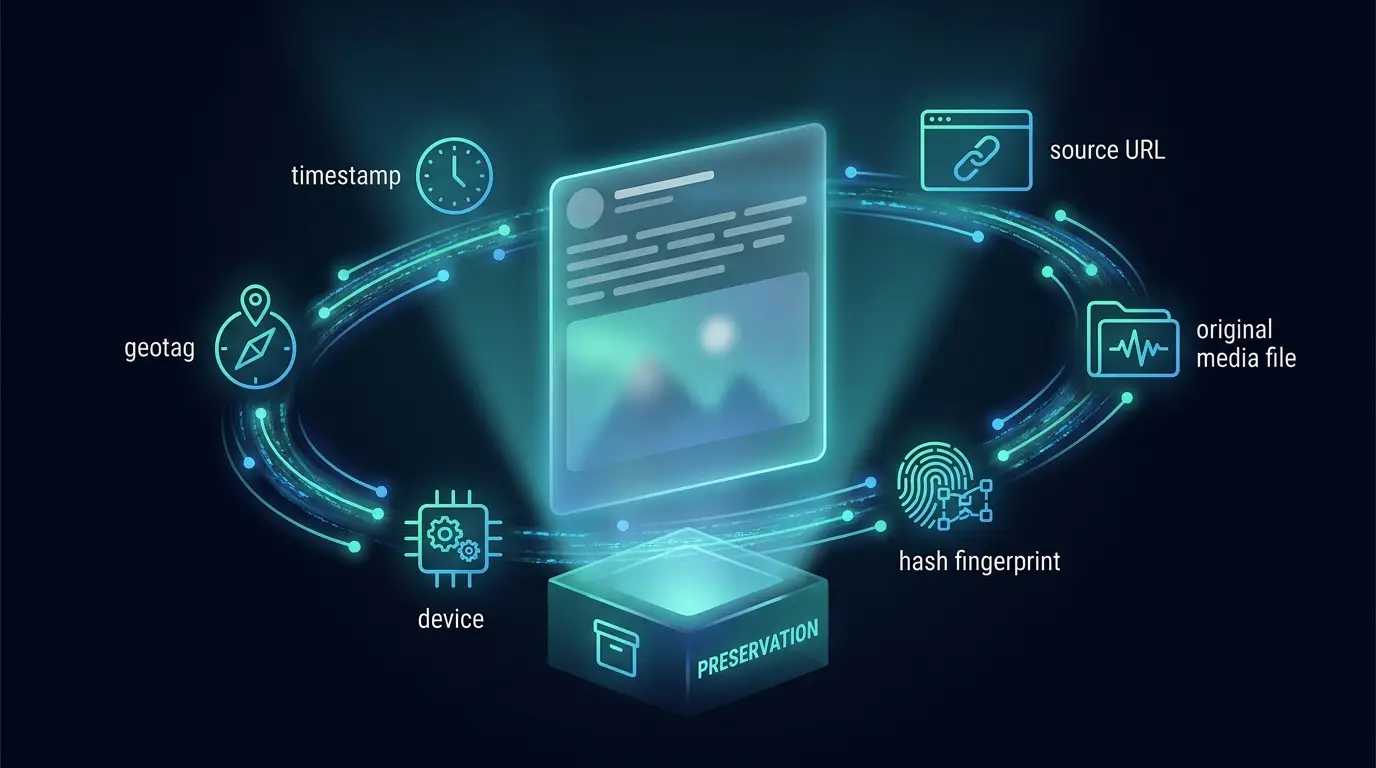
Understanding what forensic social media capture gathers helps clarify why it is so much more defensible. A comprehensive social media capture of a public account or post typically includes:
- The post content: text, images, video files, and attached media as originally published;
- The post URL and platform-native post ID: the permanent address of the content on the platform;
- The account profile at time of capture: username, display name, bio, profile photo, follower count, and verification status;
- The publication timestamp: when the platform recorded the post as published by the account;
- The capture timestamp: when the collection tool archived the content, recorded in UTC;
- Comment threads: replies and nested responses up to the moment of capture;
- Engagement metrics: like, share, and view counts at the time of capture;
- Cryptographic hashes: SHA-256 fingerprints of each media file and the overall collection package;
- Collector audit log: the tool version and account that initiated the collection.
None of that travels with a screenshot. All of it is needed to authenticate social media content under the standards that courts, insurers, and regulatory bodies apply. For video content specifically, the captured media file paired with its hash is the only reliable way to prove the video has not been edited, something that is completely impossible to verify from a screenshot of a frame.
A Practical Workflow for Legal-Grade Social Media Capture
If you are collecting social media content that may end up in proceedings, here is a defensible workflow:
- Act quickly. Content can be deleted within minutes of a triggering event. The moment you identify evidence that may matter, begin collection. Social media preservation is time-sensitive in a way that almost no other evidence type is.
- Use a dedicated forensic social media capture platform. Consumer screen-recording or screenshot tools do not generate the metadata and chain-of-custody documentation that evidence standards require.
- Capture the full account, not just the relevant post. Surrounding posts often provide context and prove the account is real and has a consistent history, which strengthens authenticity arguments.
- Record your collection process. When you collected, from what device, using what tool, and under whose authorization. If you may need to testify about collection methods, your notes are the witness statement.
- Store the output securely. Evidence tampering claims are easier to defeat when collection and storage are handled by a purpose-built platform with its own audit logs, rather than files in personal cloud storage.
- Supplement with screenshots as visual aids only. In court presentations, screenshots can help a judge or jury visualize what a post looked like. They should accompany the forensic record, not replace it.
This is the workflow legal professionals, corporate investigators, and law enforcement teams use. The full guide on whether screenshots can be used as evidence covers the legal standards behind each step in greater detail.
Frequently Asked Questions
Are screenshots of social media posts admissible in court?
They can be, but they face authentication challenges. A court must be satisfied the screenshot accurately represents what appeared on screen and has not been altered. Without metadata, hash verification, or corroborating context, opposing counsel has significant room to challenge authenticity. Forensic capture avoids this problem by building verification into the collection itself.
What is forensic social media capture and how does it differ from a screenshot?
Forensic social media capture collects content directly from the platform and records all metadata alongside it: URL, post date, account details, capture timestamp, and a SHA-256 cryptographic hash. A screenshot is just an image with none of that context attached. Forensic capture is designed to survive authentication challenges; a screenshot is not.
Can a screenshot be edited to fake social media posts?
Yes, easily. Free tools and basic image editors can alter names, dates, text, and counts in seconds with results undetectable to the naked eye. Courts are well aware of this, which is why forensic-grade collection increasingly outweighs unverified screenshots in contested proceedings.
What metadata is captured in forensic social media collection?
A full forensic capture records the post URL, platform-native post ID, publication timestamp, account profile at capture, SHA-256 hash of each media file, engagement counts at capture time, full comment threads, and a collector audit log. None of this travels with a screenshot.
When is a screenshot good enough and when do I need forensic capture?
Screenshots are fine for personal reference and internal notes where authenticity will not be contested. Forensic social media capture is required whenever content may become evidence in legal proceedings, insurance investigations, employment disputes, or any situation where the opposing party might challenge whether the content is real and unaltered.
Does forensic social media capture notify the account owner?
No. Platforms like Social Evidence collect publicly available content without interacting with the target account. The owner receives no notification, similar to someone viewing a public webpage. Only content published publicly is collected, and the account is never logged into or otherwise disturbed.
Collect Social Media Evidence the Right Way
Social Evidence captures public social media accounts with SHA-256 hash verification, full metadata, and a documented chain of custody. Replace unreliable screenshots with forensic-grade social media capture that holds up in court.
Start for free